
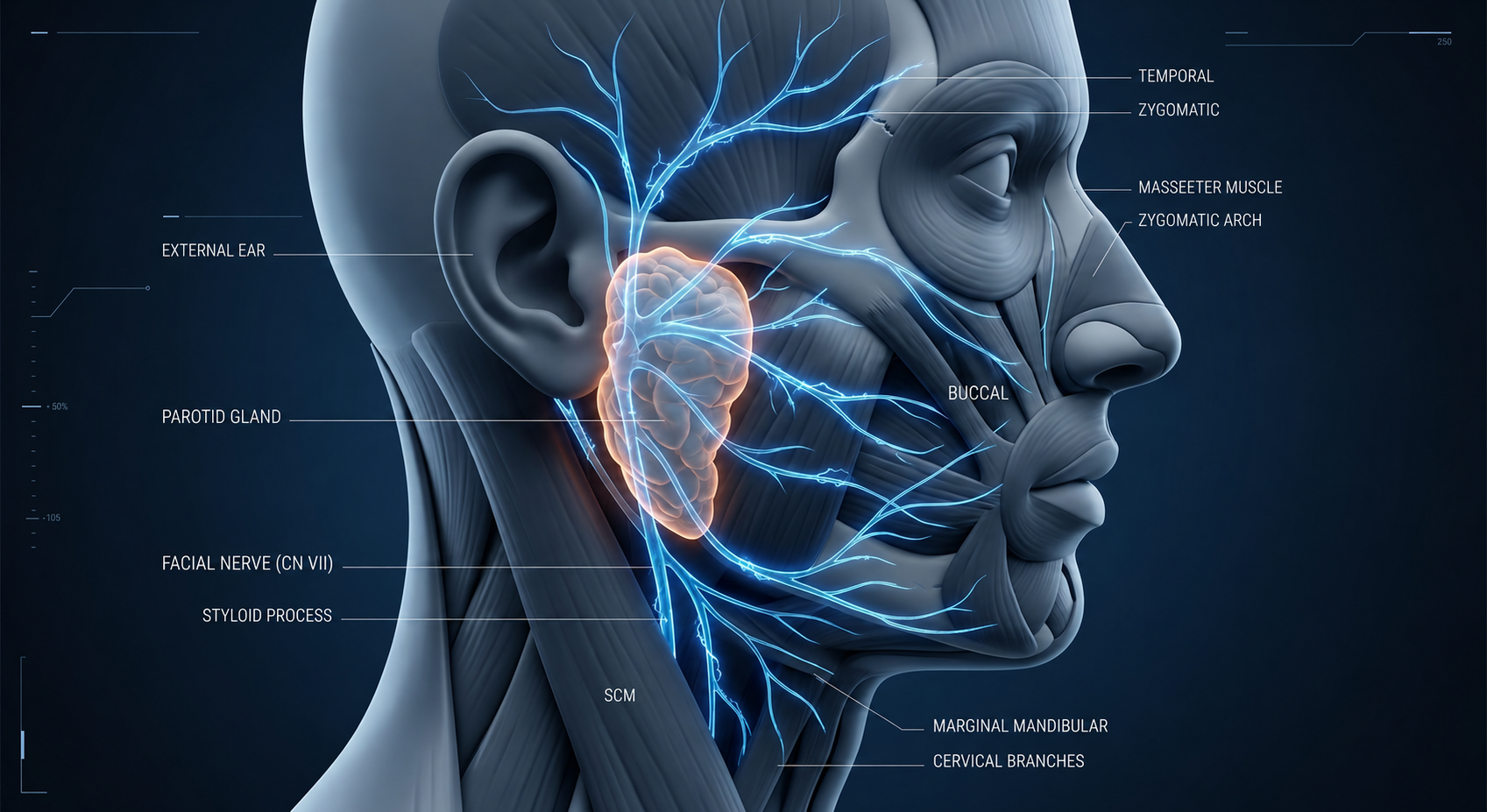
A parotid tumour is an abnormal growth or lump in the parotid gland. Most are benign, with pleomorphic adenomas and Warthin’s tumours being the most common types. Their cause is usually unknown, and they often appear as a firm swelling in the parotid gland. A smaller number are malignant, or cancerous. Malignant tumours often grow more quickly and may cause pain around the ear or weakness of the facial muscles. Australia has one of the world’s highest rates of cutaneous squamous cell carcinoma and melanoma. These skin cancers, particularly those arising on the face or scalp, can spread to small lymph nodes in or around the parotid gland and may present as a lump in this region. For this reason, any parotid-region lump should be assessed carefully, especially in people with a history of sun-related skin cancer.
Common symptoms
- A lump or swelling may appear in front of or below the ear, in the cheek, or along the jawline.
- The lump may gradually increase in size.
- Pain, tenderness or pressure may occur in the face or jaw.
- If the lump is malignant, facial nerve weakness may develop and cause facial drooping.
What investigations do I need if I notice a lump?
A parotid gland ultrasound or CT scan can help determine the lump’s size, shape and exact location. In some cases, an MRI scan may also be recommended. An ultrasound-guided fine needle aspiration biopsy is usually performed when a benign or malignant tumour is suspected. If the lump is easy to feel, Dr Bova can perform this biopsy in his office; it usually takes only a few minutes.
Do I need to remove my parotid tumour?
Surgery is recommended for most patients with a parotid tumour. Although pleomorphic adenomas are benign, they can continue to grow and carry a small but real risk of becoming cancerous over time. Small, symptom-free Warthin’s tumours may sometimes be monitored instead of removed.
What does parotidectomy involve?
Surgery to remove part or all the parotid gland is called a parotidectomy. It is performed under general anaesthetic. The incision is usually made in front of the ear and may extend into a natural skin crease in the neck, helping the scar become less noticeable over time. Because the facial nerve, which controls facial movement, passes through the parotid gland, the operation requires careful dissection and precise identification of the nerve. Dr Bova uses advanced nerve integrity monitoring during all parotidectomy procedures to help identify and preserve the facial nerve and its small branches. Once you are asleep, electrodes are placed in the facial muscles, and their activity is monitored on a computer in the operating theatre. The system provides sound and visual feedback when the facial nerve is stimulated. Patients usually stay in hospital for one to two days after parotid surgery.